
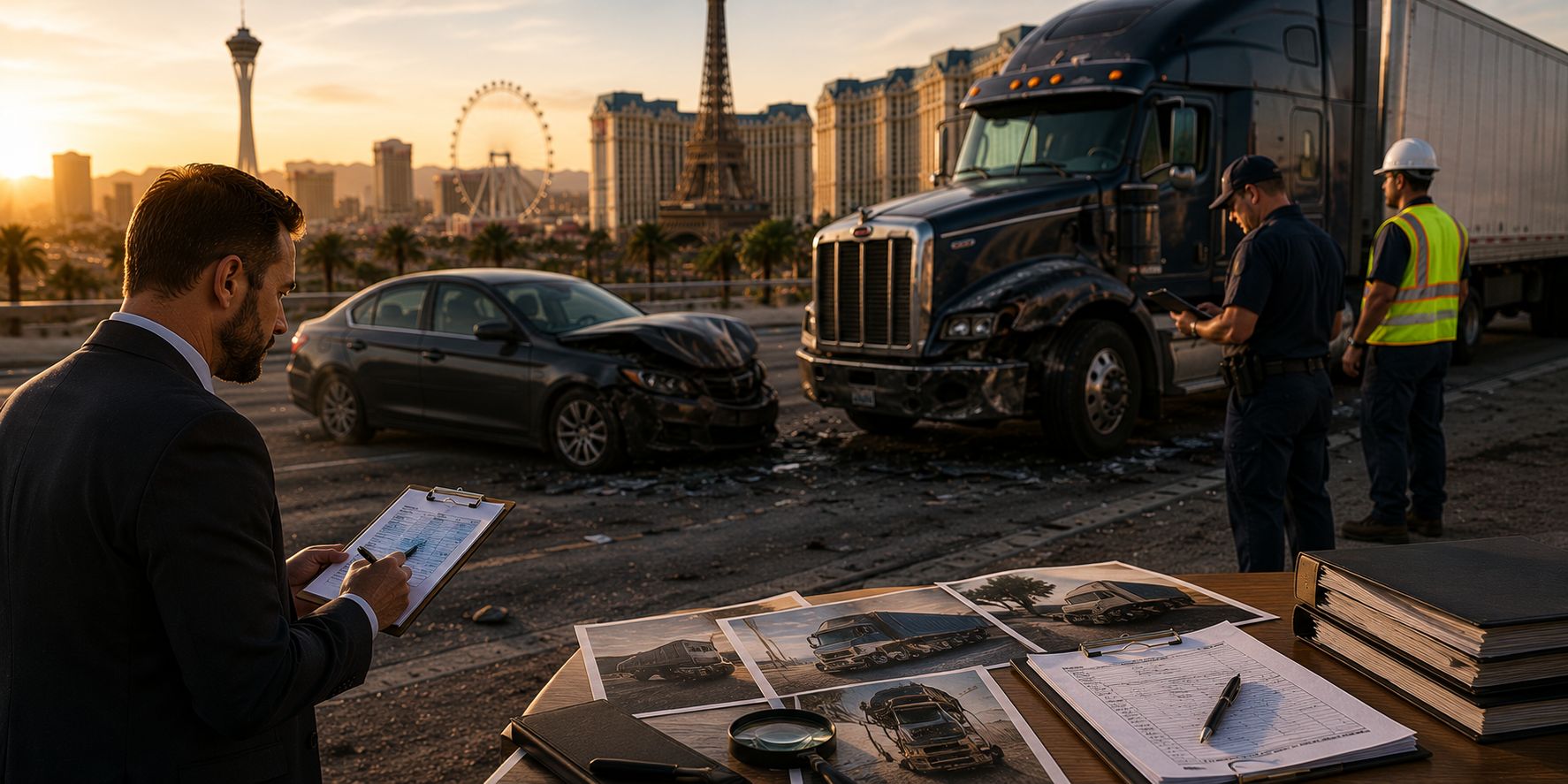
Truck Accident Liability in Las Vegas: Who Pays Beyond the Driver
Liability in a truck accident rarely stops with the driver. The motor carrier is usually responsible for its driver’s negligence, and cargo loaders, maintenance contractors, manufacturers, and freight brokers can share fault too — and because each defendant adds insurance, identifying every liable party is what drives value in a Las Vegas truck accident case and helps explain why truck settlements run higher than car accident claims. Nevada’s comparative fault rule can reduce recovery, and you generally have two years to file. Because these cases turn on federal violations and corporate discovery — is a personal injury lawyer worth it? — most injured victims contact Anchor Law for a free review.
Liability in a truck accident rarely stops with the driver. The motor carrier is usually responsible for its driver’s negligence, and cargo loaders, maintenance contractors, truck manufacturers, and sometimes freight brokers can also share fault. Each additional defendant typically adds insurance coverage — which is why identifying every liable party matters so much.
After a crash with a semi on I-15 or US-95, most people assume the case is simple: the truck driver caused the wreck, so the truck driver pays. Ask any experienced attorney who is liable in a truck accident, though, and you’ll get a different answer. Commercial trucking is built on layers — drivers, carriers, shippers, loaders, mechanics, brokers — and Nevada law lets an injured person pursue every layer that contributed to the crash.
That matters for a practical reason: the driver personally may have almost nothing, while the companies behind the driver carry substantial insurance — federal law requires interstate carriers of general freight to hold at least $750,000 in liability coverage, and many carry $1 million or more. Here’s how the full liability chain works in Las Vegas.
Who Can Be Held Liable in a Truck Accident?
Up to six categories of parties can be liable: the truck driver, the motor carrier, the cargo loading company, the maintenance contractor, the truck or parts manufacturer, and in some cases the freight broker. Most serious truck cases involve at least two of these defendants.
Here’s when each potentially liable party applies:
| Liable Party | When They’re Liable | Typical Evidence |
| Truck driver | Speeding, fatigue, distraction, impairment, traffic violations | ELD data, dashcam footage, LVMPD/NHP crash report, toxicology |
| Motor carrier (trucking company) | Vicarious liability for the driver; negligent hiring, training, or supervision; pressuring drivers to violate hours-of-service limits | Driver qualification file, training records, dispatch logs, safety history |
| Cargo loader / shipper | Improperly loaded, overloaded, or unsecured cargo causing rollover, jackknife, or lost loads | Bills of lading, loading records, weight tickets |
| Maintenance contractor | Failed brakes, tire blowouts, steering failures from negligent inspection or repair | Maintenance and inspection records, post-crash mechanical inspection |
| Truck or parts manufacturer | Defective brakes, tires, coupling systems, or other components | Product testing records, recall history, expert analysis |
| Freight broker | In some cases, selecting an unsafe or unqualified carrier to haul the load | Broker-carrier agreements, carrier safety ratings |
No two crashes involve the same mix. A rear-end crash on the I-215 may be a straightforward driver-and-carrier case; a rollover caused by shifting cargo near the Spaghetti Bowl interchange may put the loading company at the center of the claim.
Can I Sue the Trucking Company and Not Just the Driver?
Yes — in almost every case. Under the doctrine of vicarious liability, a motor carrier is legally responsible for the negligence of a driver acting within the scope of employment. The company can also be directly liable for its own negligence in hiring, training, or supervising that driver.
Vicarious liability (sometimes called respondeat superior) means you don’t have to prove the company did anything wrong itself — if its driver caused the crash while doing the company’s work, the company answers for it. This is the backbone of most truck claims, because the carrier holds the federally mandated insurance policy.
Direct negligence claims go further. A carrier can be independently liable if it:
- Hired a dangerous driver — one whose history of DUIs, suspensions, or serious crashes a reasonable background check would have revealed.
- Failed to train or supervise drivers on federal safety rules, load securement, or fatigue management.
- Pressured drivers to break the rules — unrealistic delivery schedules that can’t be met without violating hours-of-service limits are a recurring theme in serious crash cases.
Direct negligence claims also matter strategically: they open the door to the company’s internal records and safety culture, and where the conduct is egregious, they can support punitive damages.
When Is the Truck Driver Personally Liable?
The driver is liable whenever their own negligence caused the crash — speeding, following too closely, distracted driving, impairment, or driving beyond federal fatigue limits. In practice, though, the driver is usually named alongside the carrier rather than pursued alone.
Federal hours-of-service rules deserve special attention: FMCSA regulations limit commercial drivers to 11 hours of driving within a 14-hour on-duty window. Because electronic logging devices (ELDs) are federally mandated and automatically record driving time, fatigue violations — like a trucker pushing through hour 13 on a run up I-15 — are provable with the truck’s own data.
If the driver was impaired, punitive damages are possible on top of compensatory damages. And a driver who flees the scene of an injury crash commits a felony under NRS 484E.010.
How Do FMCSA Violations Prove Truck Accident Liability in Nevada?
Federal safety violations are among the most powerful liability evidence available, because they come from the trucking industry’s own mandatory records. Hours-of-service breaches, ELD data, skipped inspections, and incomplete driver files all show negligence in the company’s own handwriting.
Key federal requirements our Las Vegas truck accident attorneys examine in every case:
- Hours-of-service compliance. Did ELD data show the driver exceeded the 11-hour driving limit or the 14-hour on-duty window?
- ELD integrity. Electronic logging devices record driving time automatically. Gaps, edits, or “personal conveyance” tricks in the data are red flags.
- Record preservation. Trucking companies must preserve records, but retention periods are limited. A spoliation/preservation letter sent early in the case legally compels the carrier to retain ELD data, driver logs, dashcam footage, maintenance files, and drug-test results. If that letter doesn’t go out fast, key evidence can be lawfully destroyed in the ordinary course of business.
Insurance defense teams often reach the crash scene within hours; your evidence-preservation demand needs to move just as fast.
Why Do Multiple Defendants Mean More Compensation?
Because each liable party typically brings its own insurance policy into the case, and serious injuries can easily exceed any single policy. Identifying every defendant expands the total coverage available — often the deciding factor in catastrophic injury and wrongful death claims.
A loaded semi can weigh up to 80,000 pounds against roughly 4,000 for a passenger car, so truck crash injuries are catastrophic far more often — spinal cord damage, traumatic brain injuries, amputations — and a lifetime of care can cost millions.
The carrier’s $750,000-to-$1 million-plus policy is the starting point, not the ceiling. If the cargo loader’s negligence contributed, its commercial policy is on the table — same for the maintenance contractor, the manufacturer, and potentially the broker. A skilled attorney traces every thread of fault to every policy, because leaving a defendant out usually means leaving money on the table permanently.
How Is Fault Investigated After a Truck Crash on I-15 or US-95?
Fault is established through the official crash report, physical evidence, the truck’s electronic data, company records, and expert reconstruction. On Las Vegas freeways, that usually starts with the LVMPD or Nevada Highway Patrol investigation and builds from there.
A thorough truck crash investigation typically includes:
- The police report. LVMPD handles most surface-street crashes in the valley; NHP typically investigates crashes on I-15, US-95, and I-215. Their reports document statements, citations, and initial fault findings.
- Scene evidence. Skid marks, debris fields, vehicle resting positions, and roadway video from nearby businesses or traffic cameras.
- The truck’s own data. ELD records, engine control module data, GPS pings, and dashcam footage.
- Company records. Driver qualification files, dispatch schedules, maintenance logs, prior violations.
- Expert analysis. Accident reconstructionists translate the physical and digital evidence into a clear narrative — critical when the company’s version of events doesn’t match the physics.
Cases that don’t settle are litigated in Clark County District Court, where discovery tools — depositions of the driver, the safety director, and corporate representatives — pry loose what the company won’t volunteer.
How Does Nevada’s Comparative Fault Law Apply to Truck Accidents?
Under NRS 41.141, Nevada’s modified comparative negligence statute, you can recover compensation as long as you were 50% or less at fault, with your award reduced by your fault percentage. At 51% or more, you recover nothing.
Trucking insurers use this rule aggressively, arguing you were speeding, lingering in the truck’s blind spot, or made an unsafe lane change on US-95. Every point they pin on you cuts your recovery: on a $1,000,000 case, 30% fault means $700,000; 50% still yields $500,000; 51% yields zero.
One quirk of multi-defendant cases works in your favor: your fault is weighed against the combined fault of all defendants, so a case with a negligent driver, carrier, and cargo loader gives the defense far more fault to absorb before your share approaches the 51% bar — another reason naming every liable party matters.
What Should I Do After a Truck Accident in Las Vegas?
Call 911, get medical care immediately, document everything you safely can, and contact a truck accident lawyer before speaking with the trucking company’s insurer — the first days shape the entire case.
- Report the crash. An LVMPD or NHP report creates the official record — and if the truck fled, report immediately, because leaving the scene of an injury crash is a felony under NRS 484E.010.
- Get medical attention now, not later. Adrenaline masks injuries, and gaps in treatment become defense exhibits.
- Document the scene. Photos of the vehicles, the truck’s DOT number and company markings, skid marks, and your injuries. Get witness names and numbers.
- Say little to insurers. Do not give a recorded statement to the trucking company’s adjuster. Their rapid-response team is building a defense, not helping you.
- Get counsel involved fast. A preservation letter needs to go out immediately to lock down ELD data and company records. Remember the deadline, too: NRS 11.190(4)(e) gives you two years to file a personal injury or wrongful death suit — but the evidence won’t wait that long.
An experienced Las Vegas personal injury lawyer handles all of this while you focus on healing.
Frequently Asked Questions
Is the trucking company automatically liable for its driver’s crash?
Usually, yes. If the driver was negligent while working within the scope of their employment, the carrier is vicariously liable for the harm. The company may also face direct liability for negligent hiring, training, or supervision — and those direct claims can expose internal safety failures that support punitive damages in egregious cases.
What if the truck driver was an independent contractor?
Carriers often argue their drivers are contractors to dodge liability, but federal motor carrier rules and Nevada law limit that defense. When a driver operates under a carrier’s authority and hauls its freight, the company generally can’t contract its way out of responsibility. An attorney can analyze the operating agreement and the carrier’s actual control over the driver.
How much insurance does a trucking company have to carry?
FMCSA rules require interstate carriers of general freight to carry at least $750,000 in liability coverage, and many carry $1 million or more. That’s a dramatic difference from Nevada’s 25/50/20 minimum for private drivers — and one reason truck accident claims can fully compensate catastrophic injuries when car accident claims often can’t.
Can I still recover if I was partly at fault for the truck crash?
Yes, as long as you were 50% or less at fault. Under NRS 41.141, your recovery is reduced by your percentage of fault — 20% fault on a $500,000 case means $400,000. Because your fault is compared against all defendants combined, identifying multiple liable parties can also help keep your share below the cutoff.
What is a spoliation letter and why does it matter?
A spoliation (preservation) letter is a formal legal demand requiring the trucking company to preserve evidence — ELD data, driver logs, dashcam video, maintenance records, and personnel files. Without it, records can be lawfully destroyed under routine retention policies. Sending it within days of the crash is one of the most important moves in any truck case.
How long do I have to sue after a Las Vegas truck accident?
Two years from the date of the crash for personal injury or wrongful death claims under NRS 11.190(4)(e), and three years for property damage. Don’t treat that as breathing room — critical trucking records can disappear within weeks unless preserved, so the real deadline for action is much sooner.
Find Out Who Is Liable for Your Truck Accident — Free Case Review
Figuring out who is liable in a truck accident takes fast investigation, federal-regulation know-how, and the resources to take on carriers and their insurers. Anchor Law sends preservation letters immediately, traces every liable party from the driver to the broker, and doesn’t settle for less than the full chain of responsibility can pay.
Schedule your free consultation today — you pay no fee unless we win. We’re available 24/7, and Se Habla Español.
Call (702) 848-OUCH / (702) 848-6824 or visit us at 2300 W. Sahara Ave., Suite 1100, Las Vegas, NV 89102.