
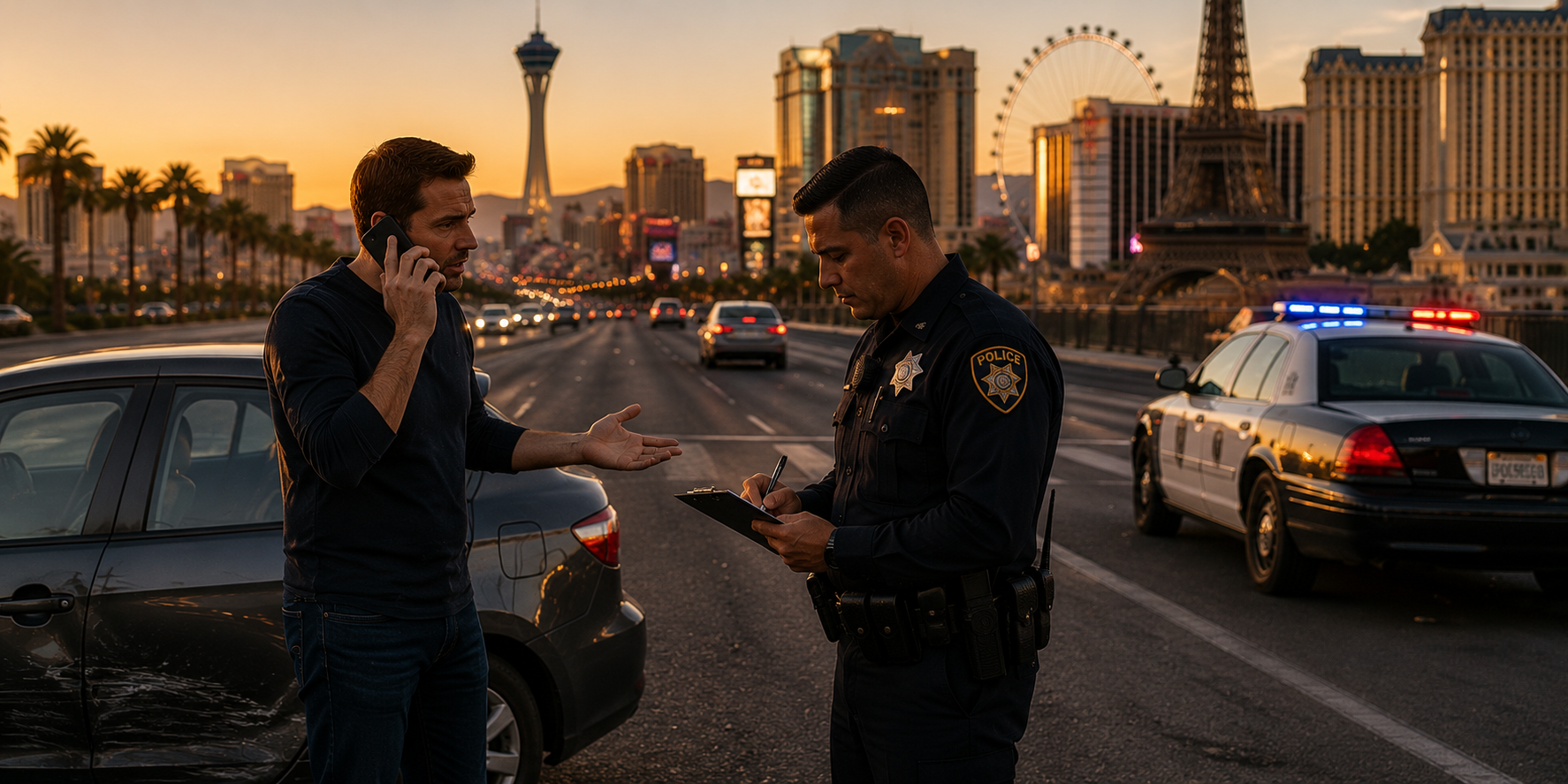
After a Hit-and-Run in Las Vegas: What to Do and How to Recover
After a hit-and-run in Las Vegas, do not chase the driver — call 911, get medical care, photograph the scene, gather witnesses, and get nearby surveillance preserved fast. Even if the driver is never found, you can often recover through your own UM/UIM coverage, MedPay, or health insurance; and if the at-fault driver is identified you pursue their liability policy — what that is worth tracks average personal injury settlement amounts in Las Vegas. Nevada generally gives you two years to file, so evidence and deadlines both favor acting quickly. Because UM claims turn adversarial fast — is a personal injury lawyer worth it? — most victims contact Anchor Law for a free review.
After a hit and run in Las Vegas, don’t chase the driver. Call 911, get medical care, photograph the scene, collect witness contacts, and request nearby surveillance footage fast. Even if the driver is never found, you can often recover compensation through your own uninsured motorist (UM/UIM) coverage, MedPay, or health insurance.
A hit and run in Las Vegas leaves you with two problems at once: the injuries from the crash, and the empty space where the at-fault driver should be. No exchanged insurance card, no license plate, no one to send the bill to. It feels like a dead end. In most cases, it isn’t.
Hit-and-run crashes rose sharply across Las Vegas in 2025, and they happen everywhere from the I-15 and US-95 interchanges to surface streets like Boulder Highway and Charleston Blvd. Nevada law treats fleeing drivers harshly — leaving the scene of an injury crash is a felony — and Nevada insurance law gives victims real paths to compensation even when the driver is never identified. This guide walks you through exactly what to do, step by step, starting from the moment of impact.
What Should You Do Immediately After a Hit-and-Run in Las Vegas?
Stay at the scene, call 911, and start documenting — do not chase the fleeing driver. Your safety and the evidence you preserve in the first hour matter far more than a pursuit you will probably lose and that could get you hurt again or accused of causing a second crash.
Here is the step-by-step sequence:
- Do not chase. Following a fleeing driver through Las Vegas traffic is dangerous, and if you cause a collision during the pursuit, you may share fault under Nevada’s comparative negligence rules. Note what you can — plate digits, make, model, color, direction of travel — and let LVMPD do the chasing.
- Call 911 immediately. A police report is essential for both the criminal investigation and your insurance claim. Many UM policies require that a hit and run be reported to police promptly.
- Get medical attention. Adrenaline masks injuries. Let paramedics evaluate you, and follow up with a doctor within 24–72 hours even if you feel “mostly fine.” Gaps in treatment become gaps in your claim.
- Photograph everything. The damage to your vehicle, debris in the road (paint transfer and broken parts can identify the other car), skid marks, the intersection, traffic signals, and your visible injuries.
- Find witnesses right away. Get names and cell numbers before people drift off. A witness who saw even a partial plate can crack a case open.
- Note nearby cameras. This is Las Vegas — casinos, gas stations, apartment complexes, and businesses record everything. Write down which properties face the crash location.
Why Does Surveillance Footage Matter So Much — and Why the Rush?
Because in Las Vegas, someone’s camera almost certainly recorded the crash or the fleeing vehicle — but most systems overwrite footage within days. Casino and business surveillance, residential doorbell cameras, and traffic cameras along corridors like the Strip and Boulder Highway can identify a fleeing driver, but only if the footage is preserved before it’s gone.
Most commercial systems recycle storage on a rolling basis — sometimes 72 hours, sometimes a week or two. Businesses generally won’t hand raw footage to a private citizen, but they will preserve it in response to a police request or a preservation letter from a law firm. This is one of the first things our office does in every hit and run Las Vegas case: we send preservation letters to every camera-equipped property near the scene the same week we’re retained. If you wait a month to act, the single best piece of evidence in your case may already be erased.
While you’re still at the scene, simply photographing which businesses and intersections have visible cameras gives your attorney a target list.
How Do Police Track Down Hit-and-Run Drivers?
LVMPD identifies fleeing drivers through physical evidence, surveillance video, witness accounts, and follow-up detective work. Paint transfer and broken parts left at the scene can narrow the vehicle to a specific make, model, and year. Partial plates get run against vehicle registration databases. Body shops sometimes report suspicious front-end repairs.
Fatal and serious-injury hit-and-runs get the most investigative resources, which matters given that Las Vegas recorded 127 traffic deaths in 2025 and more than 20,000 crashes a year — roughly 56 every day. Detectives cross-reference camera footage along the fleeing driver’s route, and in a city as heavily surveilled as this one, a driver who flees from a crash near the Strip or a major intersection often appears on multiple recordings within a mile.
Realistically, though, many hit-and-run drivers are never identified. That is why the insurance strategy below is just as important as the police investigation — your financial recovery should never depend entirely on whether the driver gets caught.
Is a Hit-and-Run a Felony in Nevada?
Yes. Under NRS 484E.010, leaving the scene of a crash involving injury or death is a category B felony in Nevada. Drivers involved in an injury crash are legally required to stop, render aid, and exchange information. Fleeing converts a traffic collision into a serious criminal case carrying potential prison time.
Why does this matter to you as the victim? Three reasons. First, the felony classification means police take these investigations seriously. Second, if the driver is caught and convicted, the criminal case generates evidence — admissions, plea agreements, sentencing findings — that strengthens your civil claim. Third, fleeing the scene is exactly the kind of egregious conduct that can support a claim for punitive damages in a civil lawsuit, on top of your compensatory damages. Drivers usually flee for a reason: no insurance, no license, an active warrant, or impairment. Each of those facts, once proven, tends to increase the value of the civil case.
Can I Get Compensation for a Hit and Run If the Driver Is Never Found?
Usually, yes — through your own insurance. The most important coverage is uninsured/underinsured motorist (UM/UIM), which steps into the shoes of the missing driver and pays what their liability insurance should have paid: medical bills, lost wages, and pain and suffering. A phantom, unidentified driver is treated as an uninsured driver.
UM/UIM is optional in Nevada, but insurers are legally required to offer it, so many drivers carry it without realizing it. Check your declarations page or have a lawyer check it for you — this coverage applies even when many policyholders assume it doesn’t.
Here’s how the main recovery sources compare:
| Recovery Source | Who Pays | Covers | Key Limitation |
| UM/UIM coverage | Your own auto insurer | Medical bills, lost wages, pain and suffering | Optional coverage — must be on your policy (insurers must offer it) |
| MedPay | Your own auto insurer | Medical bills regardless of fault | Optional; typically modest limits |
| Health insurance | Your health plan | Medical treatment | Subject to reimbursement liens from any settlement |
| At-fault driver (if found) | Their liability insurer or personal assets | All damages, potentially punitive damages | Nevada minimum is only 25/50/20; many fleeing drivers are uninsured |
The smartest claims often layer these sources: MedPay handles early bills, health insurance covers ongoing treatment, and the UM claim compensates the full injury — with an experienced attorney negotiating down the health insurance liens at the end so more of the settlement stays in your pocket.
What Happens If the Hit-and-Run Driver IS Identified?
If the driver is found, you pursue their liability insurance first — Nevada is an at-fault state, so their insurer is responsible for your damages. Nevada’s minimum policy is 25/50/20: $25,000 per person for bodily injury, $50,000 per crash, $20,000 for property damage. If your damages exceed those limits, your own UIM coverage can pay the difference.
A found driver also opens doors a phantom driver can’t. You can sue them personally in Clark County District Court. If they fled because they were driving drunk, punitive damages become a real possibility — and while DUI deaths in Las Vegas fell by roughly half in 2025, impaired driving remains a common reason drivers flee. And the pending felony prosecution under NRS 484E.010 creates enormous pressure on the driver and their insurer to resolve the civil claim rather than fight it.
Many drivers who flee turn out to carry no insurance at all. In that scenario, your UM coverage remains the primary path, exactly as if the driver had never been found.
What Deadlines Apply to a Nevada Hit-and-Run Claim?
Under NRS 11.190(4)(e), you have two years from the crash to file a personal injury or wrongful death lawsuit in Nevada, and three years for property damage claims. Miss the deadline and your claim is almost certainly gone forever, no matter how strong it was.
But the statute of limitations is only the outer boundary. The deadlines that actually decide hit-and-run cases are much shorter:
- Police reporting: immediately. Many UM policies require prompt police notification for hit-and-run claims.
- Insurer notification: your policy likely requires notice of a UM claim within a “reasonable” or specified time. Late notice gives the insurer an excuse to deny.
- Surveillance footage: days to weeks before it’s overwritten.
- Physical evidence and witness memory: degrading from day one.
Treat the two-year statute as a backstop, not a schedule. The cases that settle well are the ones where the evidence was locked down in the first month.
Why Do You Need a Lawyer for a UM/UIM Claim?
Because in a UM claim, your own insurance company becomes your adversary. This surprises people. You’ve paid premiums for years; you expect your insurer to be on your side. But the moment you file a UM claim, your insurer occupies the exact position the fleeing driver’s insurer would have occupied — every dollar it pays you comes off its bottom line, so it has a direct financial incentive to minimize your injuries, question your treatment, and offer less than the claim is worth.
Common insurer tactics in Nevada UM claims include disputing whether a hit and run actually occurred (demanding corroboration), arguing your injuries pre-existed the crash, and invoking NRS 41.141 — Nevada’s modified comparative negligence rule — to claim you were partially at fault. Under that statute, you recover nothing if you’re found more than 50% at fault, and your award is reduced by your percentage of fault below that line.
The numbers on representation are stark: Insurance Research Council data shows claimants with attorneys receive settlements roughly 3.5 times larger on average than unrepresented claimants. A Las Vegas personal injury lawyer levels the field — preserving footage, documenting damages, valuing the claim correctly, and, if the insurer won’t pay fairly, litigating in Clark County District Court. Our Las Vegas car accident lawyers handle hit-and-run and UM claims on contingency, so the insurer’s lawyers are matched by yours at no upfront cost.
Frequently Asked Questions
Will my insurance rates go up if I file a UM claim for a hit and run?
Nevada law generally protects policyholders from being penalized for not-at-fault claims, and a hit and run where you did nothing wrong is the classic example. Insurers cannot lawfully treat you as high-risk simply because a criminal struck your car and fled. If your insurer hints otherwise, that’s a red flag worth discussing with an attorney.
What if I only got a partial license plate?
Report every digit you remember to LVMPD immediately — partial plates combined with the vehicle’s make, model, and color are often enough for investigators to generate a short list of registered vehicles. Even fragments matter. Write the digits down the moment you’re safe, before memory fades, and give the same information to your attorney for the civil investigation.
Does UM coverage apply if I was a pedestrian or cyclist when hit?
In most cases, yes. UM/UIM coverage typically follows the person, not the vehicle — so if a hit-and-run driver strikes you while you’re walking on Charleston Blvd or riding a bike in Summerlin, your own auto policy’s UM coverage can still pay your injury claim. Most victims have no idea this protection exists.
How long does a hit-and-run UM claim take to resolve?
Typical UM claims resolve in several months to over a year, depending on the severity of your injuries and how reasonably your insurer behaves. You generally shouldn’t settle before your medical picture is clear — future treatment is part of the claim. If the insurer lowballs, arbitration or a lawsuit extends the timeline but often increases the outcome.
What if the hit-and-run driver was in a stolen car?
You would still typically pursue your own UM coverage, because the car owner’s insurance usually doesn’t cover a thief’s driving. This is a common scenario in Las Vegas hit-and-run cases and one more reason UM/UIM is the most important coverage on your policy. An attorney can sort out which policies apply.
Should I give a recorded statement to my insurance company?
Not before speaking with a lawyer. In a UM claim your insurer is your adversary, and recorded statements are taken to find inconsistencies that justify reducing or denying your claim. You have a duty to cooperate with your own insurer, but cooperation doesn’t require an unprepared recorded interview.
Talk to a Las Vegas Hit-and-Run Lawyer for Free
If you were the victim of a hit and run in Las Vegas — whether the driver was caught or vanished into traffic on I-15 — Anchor Law can preserve the evidence, find every layer of coverage, and deal with the insurance company so you can focus on healing. We know how UM/UIM claims really work, and we don’t let insurers treat victims like suspects.
Your consultation is free, and you pay no fee unless we win. We’re available 24/7, and Se Habla Español.
Call (702) 848-OUCH / (702) 848-6824 or request your free consultation online.
Anchor Law — 2300 W. Sahara Ave., Suite 1100, Las Vegas, NV 89102