
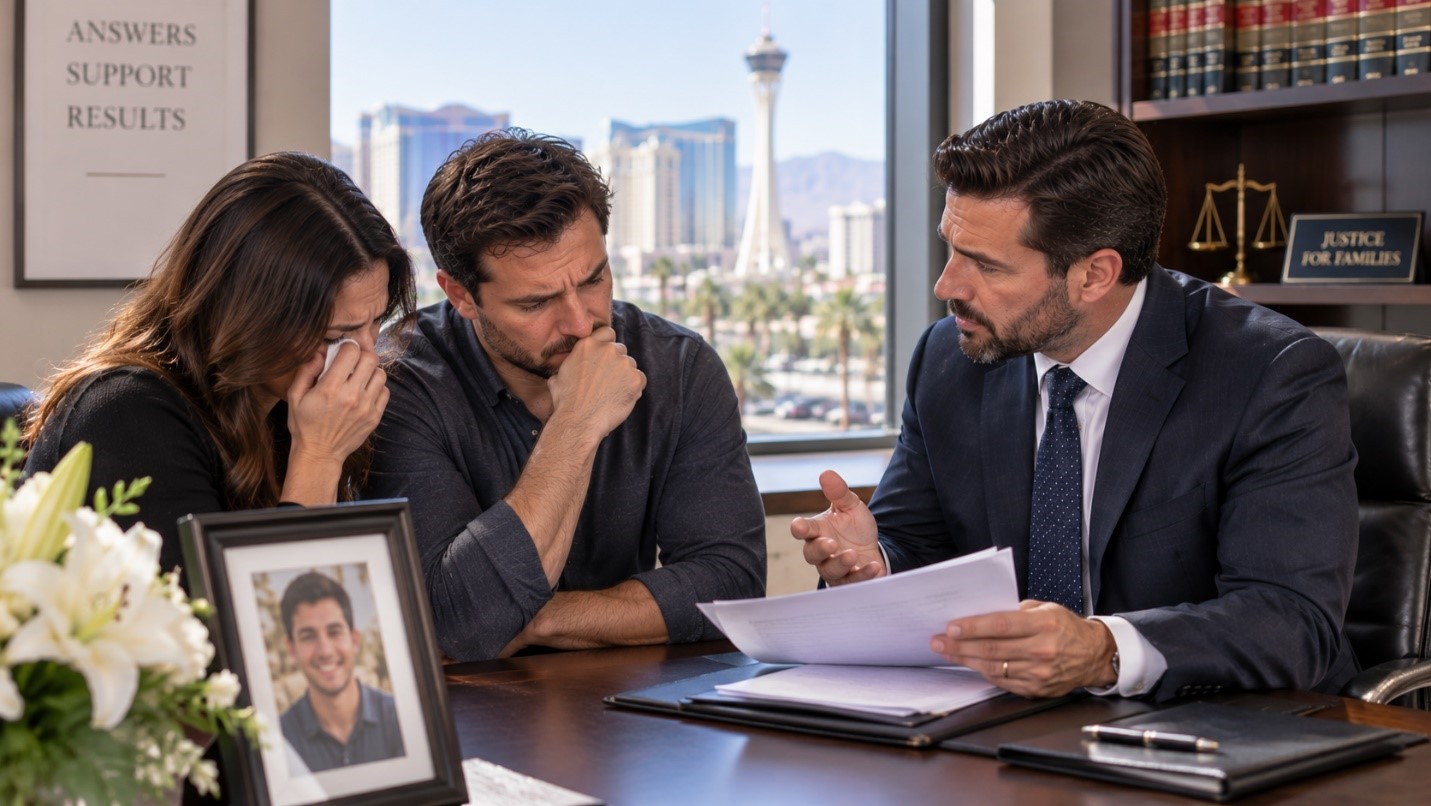
Nevada law allows specific surviving family members, and sometimes the personal representative of the estate, to file a wrongful death claim after a fatal accident caused by someone else’s negligence. Anchor Law’s wrongful death attorneys help grieving families understand who qualifies to file and what compensation may be available, and a free consultation can answer your questions during an incredibly difficult time.
What Qualifies as a Wrongful Death Under Nevada Law?
A wrongful death claim arises whenever a person’s death is caused by the negligent, reckless, or intentional conduct of another person or company. In the Las Vegas area, this most often involves fatal car, truck, motorcycle, pedestrian, or rideshare accidents, but it can also stem from a fatal slip and fall, a dog attack, defective products, or medical negligence. Nevada law, under NRS 41.085, allows a wrongful death claim to move forward independently of, or alongside, any criminal charges connected to the death.
These cases sit among the most difficult a family will ever face, arriving without warning and forcing decisions about legal rights at the exact moment grief makes decision-making hardest. Understanding the basic framework now, before you need it, can make the process feel a little less overwhelming if the unthinkable ever happens.
Wrongful Death Claims Versus a Survival Action
Nevada also recognizes a related but distinct legal action called a survival action, which allows the deceased’s estate to recover for the pain, suffering, and medical expenses the victim personally experienced between the injury and their death, separate from the family’s own wrongful death damages. In cases where a loved one survived for hours or days after a catastrophic injury before passing away, both a wrongful death claim and a survival action may apply, and pursuing both together ensures no category of compensation is overlooked.
Who Is Legally Allowed to File a Wrongful Death Claim in Nevada?
- The surviving spouse of the deceased
- Surviving children, including minor and adult children
- Parents of the deceased, when there is no surviving spouse or children
- The personal representative of the deceased’s estate, acting on behalf of the heirs
What Compensation Is Available to a Nevada Family?
Nevada law recognizes that a family’s losses after a wrongful death extend well beyond the immediate financial costs, and it allows recovery for both the tangible expenses and the deeply personal impact of losing a loved one.
- Funeral, burial, and related final expenses
- Medical bills incurred between the injury and the death
- Loss of the financial support the deceased would have provided
- Loss of the deceased’s care, guidance, companionship, and consortium
- Grief and sorrow experienced by surviving family members, which Nevada law specifically allows
How Is Compensation Divided Among Surviving Family Members?
When more than one qualifying family member survives, Nevada law generally directs the court or a settlement agreement to apportion compensation among them based on their relationship to the deceased and their individual losses, such as a surviving spouse’s loss of companionship compared to an adult child’s loss of guidance and support. Because these cases often involve more than one claimant with potentially different interests, having a single experienced legal team coordinate the claim helps keep the family aligned and avoids unnecessary conflict during an already painful time.
Wrongful Death Claims Versus Criminal Charges
A wrongful death claim is a separate civil action from any criminal case that may arise from the same fatal accident, such as charges for DUI or reckless driving. A criminal case is brought by the state and focused on punishment, while a wrongful death claim is brought by the family and focused on financial compensation, which means your family’s right to pursue damages does not depend on whether prosecutors choose to file charges, or on the outcome of any criminal trial.
How a Personal Representative Is Chosen for the Estate
When a wrongful death claim is brought on behalf of the estate rather than by an individual heir directly, Nevada law generally looks to whoever the deceased named in a will, or, absent a will, to a close family member appointed through the probate court, to serve as personal representative. This person acts on behalf of all the heirs collectively, and any recovery is typically distributed among family members according to Nevada’s intestate succession rules or the terms of a valid will, which makes coordinating everyone’s interests through a single legal team especially important.
The Financial Reality Families Face After a Sudden Loss
Beyond the grief of losing a loved one, families are often confronted almost immediately with funeral costs, outstanding medical bills, and the sudden loss of a paycheck the household depended on. Mortgage payments, childcare costs, and everyday bills do not pause for mourning, and insurance companies are frequently aware of this financial pressure, sometimes using it to justify a fast, undervalued settlement offer before a family has had time to understand the true long-term value of their loss.
A fair wrongful death settlement should account not just for the years of income the deceased would have earned, but also for benefits, retirement contributions, and the practical value of everyday tasks they handled for the household. Families are rarely in a position to calculate all of this alone in the immediate aftermath of a loss, which is one more reason an experienced attorney’s involvement early in the process protects the family’s long-term financial stability.
Can Punitive Damages Apply in a Nevada Wrongful Death Case?
In cases involving especially reckless conduct, such as a drunk driving crash or a company that knowingly ignored a dangerous safety violation, Nevada law may allow a family to pursue punitive damages in addition to standard compensation. These damages are intended to punish egregious conduct and deter similar behavior in the future, rather than to compensate the family directly, and whether they apply depends heavily on the specific facts of how the death occurred.
Determining whether punitive damages may apply requires a detailed look at the at-fault party’s conduct, prior safety record, and, in cases involving a company, its internal policies and training practices leading up to the fatal incident. This kind of investigation goes well beyond a standard insurance claim and often benefits from an attorney experienced in handling both personal injury and more complex corporate negligence cases.
How Long Do You Have to File a Wrongful Death Claim in Nevada?
Nevada generally allows two years from the date of death to file a wrongful death claim, though this deadline can shift depending on the circumstances, such as when a government entity is involved, which often requires written notice within a much shorter window. Evidence connected to a fatal accident, including surveillance footage, vehicle data, and witness memories, fades quickly, so speaking with an attorney soon after a loss protects your family’s ability to hold the responsible party accountable.
Common Causes of Fatal Accidents in Las Vegas
- High-speed collisions on I-15, US-95, and the Las Vegas Strip
- Commercial trucking accidents involving fatigued or improperly trained drivers
- Rideshare and pedestrian accidents in heavily trafficked tourist corridors
- Falls and other fatal incidents on casino and hotel property
Steps a Family Should Take After a Fatal Accident in Las Vegas
- Request a copy of the official police report as soon as it becomes available
- Preserve any photos, messages, or documents connected to the accident or the days leading up to it
- Avoid speaking with the at-fault party’s insurance company before consulting an attorney
- Keep records of funeral costs, medical bills, and any income the deceased was providing to the household
- Reach out to a wrongful death attorney early, even before every detail feels fully clear
What to Expect During a Wrongful Death Case
Wrongful death cases move through many of the same investigative steps as other personal injury claims, gathering police reports, medical records, and witness statements, but they also require careful attention to who holds legal standing to bring the claim and how any recovery is distributed among surviving family members. Anchor Law handles this process with sensitivity, keeping your family informed at every stage while pursuing the responsible party as aggressively as any other case we take on.
Why a Las Vegas Wrongful Death Lawyer Matters for Your Family
Losing a loved one because of someone else’s negligence is devastating, and navigating Nevada’s legal requirements while grieving should not fall entirely on your family. Our wrongful death attorneys handle every conversation with insurance companies, gather the evidence needed to prove liability, and pursue full and fair compensation on a contingency-fee basis, so there is never an upfront cost to your family.
Contact Anchor Law for a free consultation to understand your rights and options moving forward.