
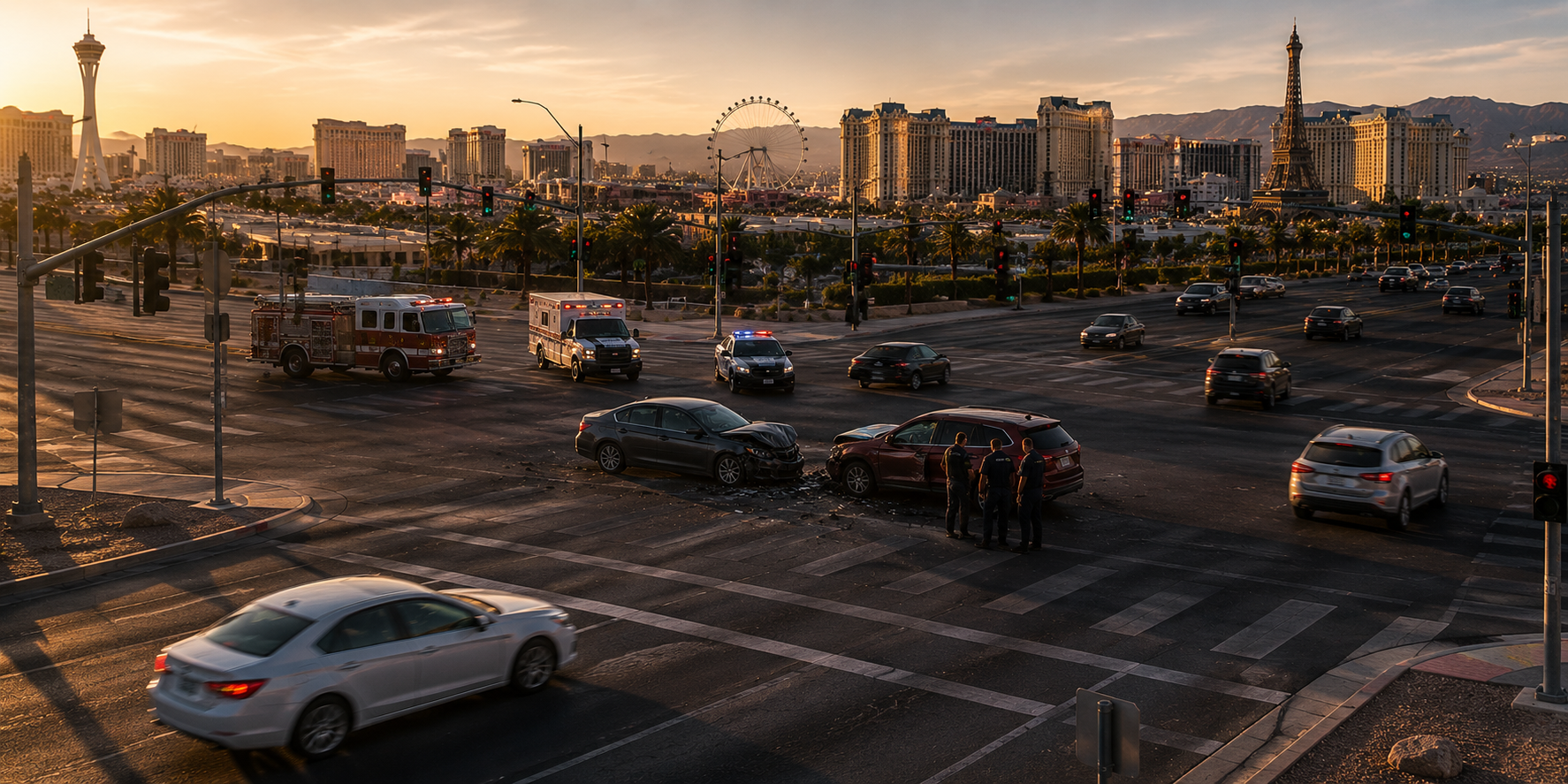
Las Vegas’s Most Dangerous Intersections and Corridors (2026)
According to 2025 LVMPD data, a handful of Las Vegas intersections and corridors — led by Charleston Blvd & Rainbow Blvd — account for a disproportionate share of the valley’s crashes, injuries, and deaths. If you are hurt at one of them, fault usually turns on right-of-way, and the at-fault driver and their insurer are responsible for your losses — what the claim is worth tracks average personal injury settlement amounts in Las Vegas. Nevada generally gives you two years to file. Because intersection cases hinge on location evidence and disputed right-of-way — is a personal injury lawyer worth it? — most injured drivers contact Anchor Law for a free review.
According to LVMPD data from 2025, the most dangerous intersection in Las Vegas is Charleston Blvd & Rainbow Blvd, which poses the highest risk to pedestrians and motorcyclists. Flamingo Rd & Rainbow Blvd (26 crashes) and Eastern Ave & Sahara Ave (24 crashes) round out the top three, with Boulder Highway and the Strip among the valley’s most hazardous corridors.
Las Vegas drivers already know the valley’s roads can be brutal — the numbers make it official. The city recorded 127 traffic deaths in 2025 and sees more than 20,000 crashes annually, roughly 56 per day. Those crashes aren’t spread evenly: a handful of intersections and corridors account for a disproportionate share of the wrecks, injuries, and deaths.
Knowing the most dangerous intersections in Las Vegas can help you drive more defensively — and if you’ve already been hit at one of them, that location data can actually strengthen your injury claim. Below is our updated 2026 list, built on LVMPD’s 2025 intersection data and the valley’s historically high-crash corridors, plus what to do if you’ve been hurt at one of them.
What Are the Most Dangerous Intersections in Las Vegas?
Per LVMPD’s 2025 data, Charleston Blvd & Rainbow Blvd is the most dangerous intersection in the valley, followed by Flamingo Rd & Rainbow Blvd with 26 crashes and Eastern Ave & Sahara Ave with 24. Several other corridors — Boulder Highway, the Strip, and stretches of Sahara and Rainbow — round out the list.
Here’s the full countdown, combining LVMPD’s 2025 intersections with corridors that earned their reputation over years of crash history:
1. Charleston Blvd & Rainbow Blvd — the most dangerous intersection in the valley
LVMPD’s 2025 data names this west-valley crossing the most dangerous intersection overall, and the highest-risk location in the city for pedestrians and motorcyclists. Heavy commuter volume meets retail traffic, wide crossing distances, and frequent left-turn conflicts.
2. Flamingo Rd & Rainbow Blvd — 26 crashes in 2025 (YTD)
A couple of miles south on the same troubled corridor, Flamingo & Rainbow logged 26 crashes year-to-date in 2025 per LVMPD. Flamingo Road funnels dense east–west traffic between the resort corridor and the western suburbs, and constant turning movements produce a steady stream of angle and left-turn collisions.
3. Eastern Ave & Sahara Ave — 24 crashes in 2025 (YTD)
On the east side of the valley, Eastern & Sahara recorded 24 crashes year-to-date in 2025. Both roads are major arterials carrying heavy daily volume, and speed, signal-running, and failure-to-yield left turns keep this crossing on LVMPD’s radar.
4. Sahara Ave & Decatur Blvd — historically high-crash intersection
Sahara & Decatur has appeared on high-crash lists for years. One of the valley’s busiest east–west arterials meets Decatur here, combining high speeds with dense commercial driveways on every corner.
5. Rainbow Blvd & Tropicana Ave — historically high-crash intersection
The third Rainbow Boulevard entry on this list, Rainbow & Tropicana has a long history of collisions. Three of the valley’s worst crossings sit on the same north–south corridor — that says as much about Rainbow Boulevard itself as any single crossing.
6. Boulder Highway corridor — the valley’s most notorious roadway
Boulder Highway isn’t one bad intersection — it’s a historically high-crash corridor running southeast toward Henderson, long notorious for pedestrian danger. Wide lanes, high speeds, long gaps between marked crossings, and heavy foot traffic make it dangerous end to end.
7. Las Vegas Blvd (the Strip) — tourist traffic meets constant congestion
The Strip is a historically high-crash corridor where millions of visitors, rideshares, taxis, delivery vehicles, and jaywalking pedestrians converge. Distracted tourists unfamiliar with the roads, constant lane-changing, and around-the-clock activity create crash conditions found nowhere else in Nevada.
8. The Rainbow Blvd corridor (Charleston to Tropicana)
Connect the dots: Charleston & Rainbow (#1), Flamingo & Rainbow (#2), and Rainbow & Tropicana (#5) all sit on one stretch of road. If your commute runs down Rainbow, you pass through several of the valley’s worst crossings every day.
9. The Sahara Ave corridor (Decatur to Eastern)
The same logic applies to Sahara Avenue, home to Eastern & Sahara (#3) and Sahara & Decatur (#4). This arterial slices through the heart of the valley, and its crash history spans the corridor, not just two crossings.
10. The Spaghetti Bowl approaches (I-15 / US-95)
Technically an interchange, the Spaghetti Bowl — where I-15 meets US-95 near downtown — earns the final spot. Its tangle of merges, short weaves, and surface-street approaches creates chronic conflict points for commuters from Henderson to North Las Vegas.
Las Vegas Crash Hotspots at a Glance
| Rank | Location | 2025 Data | Why It’s Dangerous |
| 1 | Charleston Blvd & Rainbow Blvd | Most dangerous overall (LVMPD 2025) | Highest risk to pedestrians and motorcyclists; heavy volume, left-turn conflicts |
| 2 | Flamingo Rd & Rainbow Blvd | 26 crashes YTD 2025 | Dense east–west commuter flow, constant turning movements |
| 3 | Eastern Ave & Sahara Ave | 24 crashes YTD 2025 | Two major arterials, speed, failure-to-yield left turns |
| 4 | Sahara Ave & Decatur Blvd | Historically high-crash | High speeds plus dense commercial driveways |
| 5 | Rainbow Blvd & Tropicana Ave | Historically high-crash | Third hotspot on the troubled Rainbow corridor |
| 6 | Boulder Highway corridor | Historically high-crash | Wide, fast road; notorious for pedestrian danger toward Henderson |
| 7 | Las Vegas Blvd (the Strip) | Historically high-crash | Tourist traffic, rideshare congestion, pedestrians 24/7 |
| 8 | Rainbow Blvd corridor | Contains hotspots #1, #2, #5 | Corridor-wide crash pattern |
| 9 | Sahara Ave corridor | Contains hotspots #3, #4 | Corridor-wide crash pattern |
| 10 | Spaghetti Bowl (I-15/US-95) | Historically high-crash interchange | Merging conflicts, short weaves, heavy volume |
Why Do These Las Vegas Intersections Cause So Many Crashes?
Driver behavior is the overwhelming cause: over 90% of Las Vegas crashes are linked to unlawful driver conduct, and failure to yield is the top cause of fatal crashes. Road design, tourist traffic, construction, and poor nighttime visibility amplify the risk at these specific locations.
Break that down:
- Failure to yield. The #1 cause of fatal crashes in Las Vegas — most often a driver turning left across oncoming traffic at wide, busy intersections like these.
- Speed on wide arterials. Roads like Sahara, Charleston, and Boulder Highway are built wide and straight, inviting speeds far above what’s safe around cross-traffic and pedestrians.
- Tourist and rideshare traffic. Millions of visitors unfamiliar with valley roads, plus constant rideshare pickups and drop-offs, create unpredictable movements on the Strip and nearby arterials.
- Nighttime conditions. Las Vegas runs 24 hours, and poor lighting on long arterial stretches contributes to nighttime pedestrian collisions, especially along Boulder Highway.
- Construction. Lane shifts and shifting signal patterns around persistent valley construction zones catch drivers off guard.
- Hit-and-run and impairment. Hit-and-run crashes rose sharply in 2025, even as DUI deaths fell by roughly half — encouraging on impairment, troubling on fleeing drivers.
What Should You Do If You’re Hit at One of These Intersections?
Call 911, get medical care immediately, photograph everything at the scene, collect witness information, and speak to a lawyer before giving the insurance company a recorded statement. Evidence at busy intersections disappears fast.
Follow these steps:
- Report the crash to police. LVMPD responds to most valley intersections; NHP covers the freeways. The official report anchors your claim — and if the other driver flees, report immediately, since leaving the scene of an injury crash is a felony under NRS 484E.010.
- Get medical attention the same day. Intersection crashes are often T-bone impacts, causing serious injuries even at moderate speeds. Delayed treatment hurts your health and your claim.
- Document the scene. Photos of vehicle positions, signal heads, skid marks, debris, and any obstructions. Note nearby businesses — their cameras may have captured the collision.
- Get witness contacts. Busy intersections mean witnesses. Their statements often decide disputed right-of-way cases.
- Watch the clock. Under NRS 11.190(4)(e), you have two years to file a personal injury or wrongful death claim in Nevada (three years for property damage).
- Talk to a lawyer before the adjuster. Our Las Vegas car accident lawyers deal with the insurance company so you don’t say something that costs you.
How Does Intersection Data Strengthen an Injury Claim?
A documented crash history at a known hotspot helps corroborate your version of events, contextualize the other driver’s negligence, and counter insurance arguments that the collision was a freak occurrence. Location evidence is often richest at high-crash intersections.
When a crash happens at a location like Charleston & Rainbow, an experienced attorney knows where to look: traffic camera footage, signal timing records, nearby business surveillance, and LVMPD’s own data on the intersection’s history. That history can matter in litigation before the Clark County District Court, where juries decide disputed right-of-way cases.
Location data can also point beyond the other driver — in rare cases, dangerous design, broken signals, or construction-zone negligence implicates additional responsible parties. Precise location evidence also helps reconstruction experts model speeds, sight lines, and reaction times with confidence.
Who Is at Fault in a Las Vegas Intersection Accident?
Fault turns on right-of-way: the driver who failed to yield, ran the light, or turned left into oncoming traffic is usually liable. Under NRS 41.141, Nevada’s modified comparative negligence rule, you can recover as long as you were 50% or less at fault, reduced by your fault percentage.
Intersection cases are fertile ground for fault disputes: the left-turning driver blames the through driver’s speed; the through driver blames the turn. Insurers exploit that ambiguity — if your damages are $200,000 and they pin 30% on you, they save $60,000; push you to 51%, and they pay nothing.
That’s why the evidence above — cameras, witnesses, reconstruction, LVMPD reports — matters so much. In a pure word-against-word case, the insurer controls the narrative. In a well-documented case, the physics do.
What If the Driver Who Hit You Fled the Scene?
You can still recover compensation. Uninsured motorist (UM) coverage, MedPay, and Nevada’s crime victim compensation program can all pay hit-and-run victims — and if police identify the fleeing driver, they face felony charges under NRS 484E.010 for leaving an injury crash.
Hit-and-run crashes rose sharply in Las Vegas in 2025, making this scenario common at busy intersections. Report the crash to police immediately — prompt reporting is typically required for UM claims and crime victim compensation. Nevada is an at-fault state with a 25/50/20 minimum insurance requirement, and while UM/UIM coverage is optional, insurers must offer it; if you carried it, your own policy stands in for the fleeing driver’s. A Las Vegas personal injury lawyer can identify every coverage source available, even when the at-fault driver is never found.
Frequently Asked Questions
What is the most dangerous intersection in Las Vegas?
Charleston Blvd & Rainbow Blvd, according to LVMPD’s 2025 data. It ranks as the most dangerous intersection in the valley overall and carries the highest risk for pedestrians and motorcyclists specifically. Flamingo Rd & Rainbow Blvd (26 crashes YTD 2025) and Eastern Ave & Sahara Ave (24 crashes) follow close behind.
How many car accidents happen in Las Vegas each year?
More than 20,000 crashes annually — roughly 56 every day. In 2025, the city recorded 127 traffic deaths. Over 90% of Las Vegas crashes are linked to unlawful driver behavior, with failure to yield ranking as the leading cause of fatal collisions — which is why intersections dominate the list.
Where do most accidents happen in Las Vegas?
Crashes cluster on major arterials and their intersections: the Rainbow Boulevard corridor (Charleston, Flamingo, and Tropicana crossings), the Sahara Avenue corridor (Decatur and Eastern), Boulder Highway heading toward Henderson, and Las Vegas Boulevard through the Strip. Freeway crashes concentrate on I-15, US-95, I-215, and the Spaghetti Bowl interchange.
Does it matter for my claim that the crash happened at a known dangerous intersection?
It can help. High-crash intersections tend to have more evidence available — traffic cameras, business surveillance, witnesses — and the location’s documented history can counter insurer arguments that your account is implausible. It also helps reconstruction experts model the collision accurately in disputed right-of-way cases.
Can I recover damages if I was partly at fault for an intersection crash?
Yes, if you were 50% or less at fault. Under NRS 41.141, Nevada reduces your award by your fault percentage — so 25% fault on a $100,000 claim yields $75,000. At 51% or more, you recover nothing, which is why insurers fight hard to inflate your share of blame at intersections.
What compensation can I claim after an intersection accident?
Nevada law allows recovery of medical bills, future treatment costs, lost wages, diminished earning capacity, property damage, and pain and suffering. Where the at-fault driver’s conduct was egregious — a DUI, for example — punitive damages may be available on top of your compensatory award.
Hit at a Dangerous Las Vegas Intersection? Talk to Anchor Law for Free
Crash data tells you where the danger is — but if you’ve been hit at one of the most dangerous intersections in Las Vegas, you need someone who can turn that location’s evidence into a full-value claim. Anchor Law investigates fast, secures camera footage before it’s erased, and takes on the insurance company for you.
Get your free consultation today — no fee unless we win. Available 24/7. Se Habla Español.
Call (702) 848-OUCH / (702) 848-6824 or visit us at 2300 W. Sahara Ave., Suite 1100, Las Vegas, NV 89102.